Real-World Primary Healthcare (PHC) Transformation to Tackle Child Obesity
Policy Paper
July 1, 2026
India is projected to have more than 27 million children and adolescents living with obesity by 2030, while obesity-related economic costs are projected to rise from USD 29 billion in 2019 to USD 839 billion by 2060. Yet childhood obesity remains a policy blind spot, with overweight and overnutrition not yet consistently embedded as explicit programme priorities across platforms such as POSHAN 2.0, RBSK, and Ayushman Bharat.
Developed from an expert roundtable held at Healthy Hubba at IISc Bengaluru, this policy paper presents a fiscally responsible and politically feasible pathway to transform Primary Health Care for childhood obesity prevention and management. It outlines how PHC, schools, families, and district-level governance can be aligned within a unified prevention and care architecture.
Key takeaways for public health leaders and policymakers:
- Integrate BMI screening, risk stratification, referral, and non-stigmatizing family counselling into routine PHC and school workflows
- Deploy a four-reform system spanning PHC Service Delivery, Schools as Prevention Hubs, Governance & Convergence, and Behaviour Reframing
- The economic model estimates a Benefit-Cost Ratio of approximately 9,663:1 under the full-horizon scenario, suggesting that every USD 1 invested could generate nearly USD 10,000 in discounted future economic benefits
- Implement a 24-month phased roadmap anchored largely in existing NHM, RBSK, Samagra Shiksha, Ayushman Bharat, POSHAN 2.0, and related public-sector platforms, supplemented by additional financing mechanisms where needed
- Align childhood obesity prevention with SDG 3, SDG 2.2, and Viksit Bharat 2047, while complementing rather than displacing existing undernutrition priorities
Authored by Sriram Subramani, Apoorva Mahajan, Dr. Nameeda Khaiser Syeda, and Nupur Lilaramani, under the guidance of an expert panel comprising Dr. Sreehari Madhavankutty Nair (National Health Mission, Child Health, Kerala), Dr. Sumathi Swaminathan (Associate Professor, Division of Nutrition, St. John's Research Institute), Mr. Sridhar Ranganathan (Advisor, HELYXON), Dr. Syama B Syam (Associate Director, Evidence to Impact, Swasti Health Catalyst), Dr. Jyoti Vijay (Assistant Professor, Institute of Health Management Research, IIHMR), Mr. Thongsuanmung Vualnam (Lead - Program Manager & Operations, India Health and Climate Resilience Fund, IHCRF), Ms. Srishti Srivastava (Founder & CEO, Infiheal), Ms. Apoorva Mahajan (Global Health Specialist, Solutionec) and Mr. Suraj Prasad (Founder & CEO, HLTY). The roundtable was moderated by Mr. Raj Veeravalli (Apeiro). Developed by Hlty Beings and Solutionec.
You may also be interested in

Is Your Protein Bar Just Candy with Better PR?
Is Your Post-Workout Snack Actually Junk Food?

The Great Screen Reversal: Why Sweden is Going Old School
One of the world's most tech-forward nations is halting digital learning to save literacy. Here is why Indian parents need to pause the "Smart Class" hype.
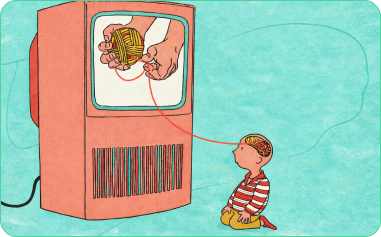
It's Not Just About Cartoons: The Silent Danger of the "Background" TV
Your child doesn't need to watch the TV for it to affect their brain.